
A VoIP call can appear successful while still failing where it matters most.
The phone registers correctly. The SIP INVITE receives a response. The call timer starts. Everything looks healthy in the signaling logs.
Then someone says:
“I can’t hear you.”
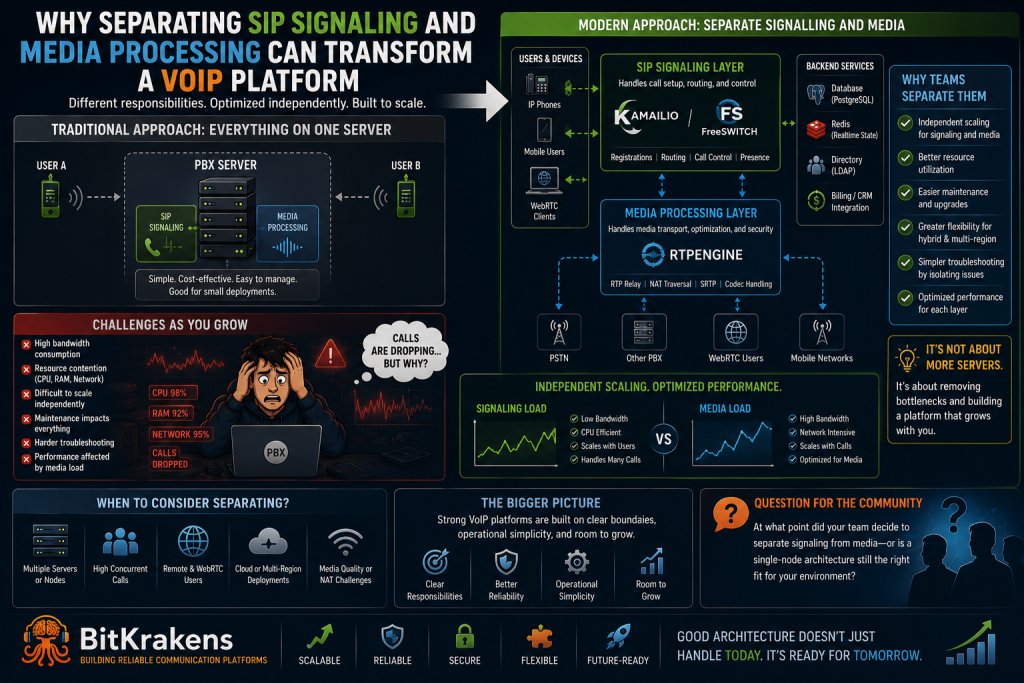
This situation highlights one of the most important architectural principles in modern VoIP: SIP signaling and media processing are connected, but they are not the same workload.
For a small PBX deployment, keeping both responsibilities on one server may be the simplest and most practical choice. It reduces infrastructure costs, deployment time, and operational overhead.
However, as concurrent calls, locations, integrations, security requirements, and availability expectations increase, running signaling and media on the same node can create resource contention and operational bottlenecks.
The important question is not whether every VoIP platform should separate them.
The real question is:
When does separating SIP signaling and media processing become the safer and more scalable design?
What Is SIP Signaling?
SIP, or Session Initiation Protocol, is the application-layer signaling protocol used to create, modify, and terminate communication sessions.
In a typical VoIP environment, SIP signaling may be responsible for:
User and endpoint registration
Authentication and authorization
Call setup and termination
SIP trunk routing
Number normalization
Routing policies
Failover decisions
Session updates
Presence and messaging functions
Communication between endpoints, proxies, PBXs, and carriers
SIP does not normally carry the continuous audio stream of a call. It coordinates how the session should be established.
RFC 3261 defines SIP as a control protocol for creating, modifying, and terminating sessions. Session details such as media types, addresses, ports, and supported formats are commonly described using SDP, or Session Description Protocol.
A SIP platform may use tools such as Kamailio, OpenSIPS, FreeSWITCH, Asterisk, FusionPBX, or a commercial session border controller. The exact responsibilities depend on the architecture.
What Is Media Processing?
After the session has been established, audio or video is commonly transported using RTP, the Real-time Transport Protocol.
Media-related systems may perform tasks such as:
Relaying RTP and RTCP packets
Handling NAT traversal
Anchoring the media path
Terminating or relaying SRTP
Transcoding between codecs
Recording calls
Mixing conference participants
Playing announcements or prompts
Processing DTMF
Bridging SIP and WebRTC media
Applying media policies
Collecting media quality statistics
RTP is designed to transport real-time data such as audio and video. SRTP adds confidentiality, authentication, and replay protection to RTP and RTCP streams.
A useful technical distinction is that codecs are usually proposed and selected through the SDP offer-and-answer exchange in the signaling path. The media server or relay may then process or transcode the selected media when required.
SIP Signaling and Media Processing Compared
| Area | SIP signaling | Media processing |
|---|---|---|
| Primary purpose | Controls and routes sessions | Transports or processes audio and video |
| Typical traffic | SIP messages | Continuous RTP and RTCP packets |
| Main resource pressure | Transactions, routing logic and database access | Bandwidth, packets per second and CPU |
| Common components | Kamailio, OpenSIPS, PBX or SBC | RTPengine, media server, SBC or PBX media engine |
| Common problems | Failed registration, rejected calls and routing errors | One-way audio, no audio, jitter and codec problems |
| Scaling pattern | Transactions and registrations | Concurrent streams and media features |
| Geographic concern | Routing and session state | Latency, packet loss and media path length |
This difference in resource behavior is the main reason signaling and media often need to scale independently.
Why a Single-Server VoIP Architecture Works Initially
A single-node architecture is not automatically a bad design.
For a smaller deployment, combining SIP signaling, PBX logic, database access, recordings, and media processing can offer several benefits:
Lower hosting costs
Fewer services to configure
Simpler firewall rules
Easier backups
Faster deployment
Less distributed troubleshooting
Reduced operational complexity
A small business PBX, internal phone system, development environment, or low-volume call center may operate reliably on one properly sized server.
Separating components too early can introduce more failure points without delivering a meaningful operational benefit.
Good architecture is not measured by the number of servers it uses. It is measured by how appropriately it supports the current workload, risk, and growth plan.
Why Growing VoIP Platforms Separate Signaling and Media
As the platform grows, the signaling and media layers can begin competing for resources.
A spike in transcoding, conference mixing, call recording, or RTP bandwidth may consume CPU and network capacity even when SIP transaction volume remains stable.
Separating the layers creates clearer resource boundaries.
1. Independent Scaling
The signaling layer can be scaled according to registrations, calls per second, routing complexity, and SIP transactions.
The media layer can be scaled according to concurrent calls, bandwidth, packet rate, transcoding, recording, conferencing, or WebRTC requirements.
Kamailio’s RTPengine integration supports multiple RTPengine instances and can distribute media sessions across defined sets, illustrating how the media tier can be scaled separately from the SIP proxy.
2. Better Resource Isolation
Media workloads can be demanding.
A large number of RTP streams may create high network throughput and packet-processing pressure. Transcoding and conference mixing can add significant CPU usage. Recordings can increase storage I/O.
When signaling shares those resources, media activity may affect registrations, routing decisions, API requests, or new call setup.
Separate nodes make it easier to reserve the right resources for each function.
3. Safer Maintenance
A media node may need kernel tuning, network changes, codec updates, capacity adjustments, or maintenance that has little to do with SIP routing.
Separating responsibilities may allow engineers to maintain or replace a media node without changing the complete signaling platform.
This does not eliminate maintenance risk. It makes the affected boundary clearer.
4. Improved Troubleshooting
When every responsibility lives on one machine, a single symptom may have many possible causes.
For example, poor audio could be related to:
Network congestion
NAT configuration
RTP port rules
Codec incompatibility
SRTP negotiation
CPU pressure
Media relay failure
Carrier routing
Endpoint behavior
A layered design helps engineers determine whether the problem is in the signaling path, media path, PBX application, carrier connection, or endpoint network.
5. More Flexible Geographic Deployment
SIP routing and media traffic do not always need to follow identical paths.
A centralized control layer may manage users and routing policies while media relays are placed closer to users, carriers, or regional network edges.
This can be valuable for multi-region operations, international calling platforms, remote workforces, and WebRTC services.
However, geographic distribution must be designed carefully. A longer or unstable media route can increase latency, jitter, and packet loss.
6. Clearer Failure Domains
A failure domain is the part of a system affected when a component fails.
When signaling, media, databases, recordings, and application logic run on one server, one resource problem can affect the entire service.
Separating layers may reduce the blast radius of certain failures. A media node can potentially be drained or removed from service while signaling continues routing new calls to healthy capacity.
This requires proper health checks, session handling, redundancy, and tested failover. Simply adding another server does not automatically create high availability.
A Common Layered VoIP Architecture
A growing platform may use a structure similar to this:
Endpoints and carriers
↓
SIP edge or proxy
Kamailio, OpenSIPS or SBC
↓
PBX or application layer
FreeSWITCH, Asterisk, call-control service or application server
↓
Media layer
RTPengine, media relay, recording service, conference server or transcoding nodes
↓
Data and operations layer
Database, Redis, message queue, CDR pipeline, monitoring and storage
In this model, the SIP proxy handles routing and policy decisions while a dedicated media platform anchors or processes RTP when required.
RTPengine, for example, is documented as a proxy for RTP and other UDP-based media traffic that can be controlled by a Kamailio SIP proxy. It can receive SDP from the proxy, rewrite the media information, and return it for insertion into the SIP message.
The exact design should reflect the platform’s real requirements. A PBX may still remain in the media path for IVR, recording, conferencing, or application logic.
When Should You Consider Separating the Layers?
There is no universal concurrent-call number that applies to every platform.
Hardware, codecs, encryption, recording, network capacity, packet rate, call duration, routing logic, virtualization, and application behavior all affect capacity.
Instead of using an arbitrary threshold, look for operational signals.
Consider separation when:
Media bandwidth is growing faster than SIP traffic
CPU usage increases during transcoding or conferencing
Call recording affects disk or application performance
One-way audio and NAT problems are difficult to isolate
Maintenance requires interrupting unrelated services
Different regions need local media handling
You need separate signaling and media failover strategies
New calls are affected by existing media load
WebRTC and SIP endpoints require media interworking
The platform needs controlled horizontal scaling
Business uptime requirements have become stricter
Capacity planning is difficult because all workloads share one node
These signals are more useful than choosing an architecture based only on the number of extensions.
When Is a Single-Node Architecture Still Better?
Separation may not be justified when:
Call volume is low and predictable
The PBX performs limited media processing
The system supports one office or a small team
The existing server has comfortable capacity
Downtime risk is relatively low
The operations team is small
Monitoring and configuration management are still immature
Distributed services would be harder to support than the current system
Before creating a multi-node architecture, strengthen the basics:
Monitoring
Backups
Restore testing
Firewall management
Configuration version control
Log retention
Capacity measurement
Certificate monitoring
Recovery documentation
A well-operated single server can be more reliable than a poorly operated cluster.
The Hidden Costs of Separating Signaling and Media
Separation provides flexibility, but it is not free.
A distributed architecture introduces additional responsibilities:
More Network Dependencies
The SIP proxy, PBX, media nodes, databases, and monitoring systems must communicate reliably.
Firewall rules, routing, private networks, DNS, certificates, and security policies become more important.
More Complex Observability
Engineers need visibility across multiple layers.
SIP traces alone may not explain an RTP problem. Media statistics alone may not explain why a call was routed incorrectly.
Useful observability should connect:
SIP transaction data
Dialog or call identifiers
RTP quality metrics
System resource metrics
Carrier responses
Application logs
Deployment changes
Alerts and ownership
More Failure Scenarios
A media cluster can fail even while SIP remains available. The signaling layer may route a call successfully to an unhealthy media node unless health checks and selection logic work correctly.
Redundancy must be tested under realistic conditions.
More Operational Skills
The team must understand both telecom behavior and infrastructure operations.
This includes SIP, SDP, RTP, NAT, Linux networking, capacity planning, monitoring, automation, security, and recovery procedures.
That is why component separation should follow operational maturity, not architectural fashion.
A Practical Migration Path
Moving away from a single-node design should be gradual.
Step 1: Measure the Existing Platform
Collect baseline information about:
Concurrent calls
Calls per second
Registrations
RTP bandwidth
Packet rate
CPU and memory
Recording I/O
Codec usage
Call failure rates
Jitter, latency and packet loss
Peak traffic periods
Without a baseline, it is difficult to prove that the new design has improved anything.
Step 2: Define Clear Responsibilities
Document which component will handle:
Registration
Authentication
Routing
NAT traversal
RTP anchoring
Transcoding
Recording
Conferencing
WebRTC interworking
Failover
Monitoring
Avoid allowing responsibilities to overlap accidentally.
Step 3: Introduce Media Relaying Selectively
Not every call must necessarily be anchored through a media relay.
Depending on security, NAT, topology, recording, carrier, and WebRTC requirements, the platform may relay media only for selected call types.
Step 4: Add Capacity and Health Checks
Media node selection should account for availability and capacity.
The platform needs a safe method to stop assigning new sessions to an unhealthy or overloaded node.
Step 5: Correlate Signaling and Media Data
Use identifiers and timestamps that make it possible to follow one call through the SIP, PBX, RTP, carrier, and application layers.
Step 6: Test Failure Conditions
Test more than successful calls.
Simulate:
A failed media node
Packet loss
High CPU usage
Network interruption
Certificate failure
Carrier timeout
Deployment rollback
Regional failure
Loss of monitoring
Partial database failure
A scalable architecture should be recoverable, not merely distributed.
The Most Important Principle
Separating SIP signaling and media processing is not about making a diagram look more advanced.
It is about allowing different responsibilities to evolve independently.
The signaling layer needs fast, reliable session control and routing.
The media layer needs predictable packet handling, bandwidth, low latency, and enough processing capacity for the required media features.
When those workloads begin creating different scaling, maintenance, geographic, or availability requirements, separating them can make the platform easier to operate and safer to grow.
When they do not, a simple architecture may still be the correct choice.
The strongest VoIP platform is not necessarily the one with the most components.
It is the one with clear boundaries, measurable capacity, tested recovery, and enough simplicity for the team operating it.
Frequently Asked Questions
What is the difference between SIP signaling and RTP media?
SIP controls session setup, routing, modification, and termination. RTP commonly carries the continuous audio or video packets after the session has been established.
Does SIP carry voice traffic?
SIP normally carries signaling messages and session information. The actual audio or video is generally transported separately using RTP or a secure form such as SRTP.
Do I need RTPengine with Kamailio?
Not every Kamailio deployment needs RTPengine. It becomes useful when the platform needs media anchoring, NAT traversal, topology control, WebRTC interworking, SRTP handling, or independent media scaling.
Should FreeSWITCH and Kamailio run on separate servers?
They can run together for smaller installations. Separate nodes may become useful when routing, application logic, media processing, failure isolation, or capacity requirements need to scale independently.
Does separating media automatically provide high availability?
No. High availability also requires health checks, redundant capacity, correct session routing, monitoring, failover logic, operational procedures, and testing.
Build the Architecture Your Call Traffic Actually Needs
Bitkrakens helps businesses review PBX servers, SIP routing, media paths, monitoring, call recording, failover requirements, and infrastructure risks.
The objective is not to add unnecessary complexity.
It is to identify where the current platform is becoming difficult to scale, troubleshoot, maintain, or recover, and create a practical architecture that matches the business requirement.
Request a VoIP infrastructure review and plan the next stage of your platform with clearer signaling, media, monitoring, and recovery boundaries.