
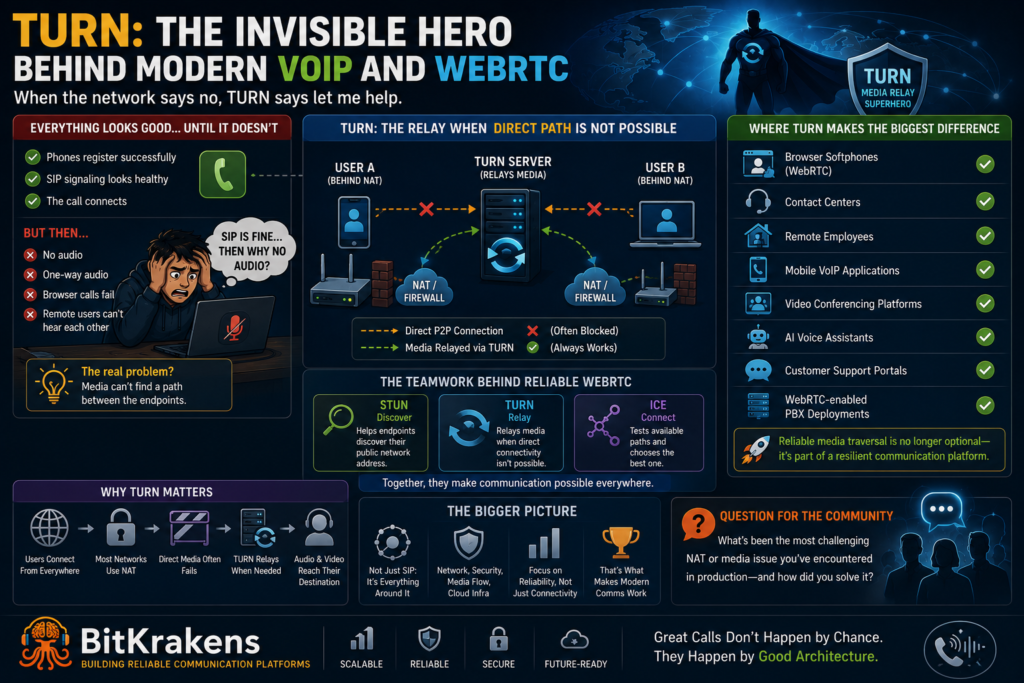
Imagine this.
Your VoIP platform looks perfectly healthy.
The phone registers successfully.
SIP signaling works.
The call connects without errors.
Then the user says:
“I can’t hear anything.”
Or perhaps only one side can hear the conversation. A browser-based softphone works in the office but fails for remote users. A WebRTC call connects, yet no audio passes between the two endpoints.
These are some of the most frustrating problems in modern VoIP and WebRTC deployments.
When this happens, engineers often start investigating the usual suspects:
FreeSWITCH
Kamailio
SIP configuration
Firewalls
RTP ports
Codecs
Network routing
All of these areas can cause media problems.
However, in many real-world deployments, the underlying issue is more fundamental:
The media traffic cannot establish a reliable path between the two endpoints.
This is where a TURN server becomes one of the most important, yet often overlooked, components of a modern real-time communications platform.
What Is a TURN Server?
TURN, or Traversal Using Relays around NAT, is a protocol designed to relay network traffic when two endpoints cannot communicate directly.
In a WebRTC environment, the preferred option is usually to establish the most efficient available connection between participants. However, direct connectivity is not always possible.
Users may be connecting through:
Home Wi-Fi routers
Mobile networks
Corporate firewalls
Carrier-grade NAT
Cloud networks
VPN connections
Restricted enterprise environments
In these situations, NAT and firewall policies can prevent media packets from reaching their destination.
A TURN server provides an alternative path.
Instead of sending media directly from one endpoint to another, the traffic is sent through the TURN relay.
The communication path may look like this:
Endpoint A → TURN Server → Endpoint B
This relay mechanism allows audio, video, and other real-time traffic to continue even when direct connectivity fails.
Why TURN Matters for Modern VoIP and WebRTC
Modern communication platforms are no longer limited to desk phones connected to the same office network.
Users expect to make and receive calls from almost anywhere.
A customer may call through a browser.
An employee may use a softphone from home.
A contact center agent may work remotely.
A mobile application may connect through a carrier network.
An AI voice application may need to communicate with users through a browser-based interface.
Every network environment is different.
Some networks allow direct media communication without problems. Others apply strict NAT rules or firewall restrictions that make direct communication difficult or impossible.
Without a reliable fallback mechanism, the result can be:
No audio
One-way audio
Failed WebRTC calls
Intermittent media
Remote connectivity problems
Calls that work on one network but fail on another
A properly configured TURN service helps reduce these connectivity problems by providing a relay path when other connection methods cannot establish reliable communication.
TURN does not replace your PBX.
It does not replace SIP.
It does not replace FreeSWITCH, Kamailio, or another signaling platform.
Instead, TURN solves a different problem.
It helps media reach its destination when the network between two endpoints does not allow a usable direct path.
STUN vs TURN vs ICE: How They Work Together
To understand modern WebRTC connectivity, it is useful to understand three important technologies:
STUN
STUN, or Session Traversal Utilities for NAT, helps an endpoint discover how it appears to the public internet.
A device inside a private network may have a local IP address such as:
192.168.x.x
That private address cannot normally be used directly by a remote internet user.
STUN helps the endpoint discover the public-facing network information that may be available for communication.
However, discovering a public address does not guarantee that a direct media connection will always succeed.
That is where TURN may be required.
TURN
TURN provides a relay server for traffic when a usable direct connection cannot be established.
Instead of relying entirely on peer-to-peer connectivity, the media passes through the TURN infrastructure.
TURN can therefore act as an important fallback mechanism in restrictive network environments.
ICE
ICE, or Interactive Connectivity Establishment, coordinates the connection process.
ICE gathers possible connection candidates and tests them to determine which available path can successfully carry communication.
Depending on the network environment, this may include:
Local network candidates
Publicly discovered candidates
TURN relay candidates
The objective is to identify a working connection path.
In simple terms:
STUN helps discover possible network paths.
TURN provides a relay when necessary.
ICE evaluates available candidates and helps establish connectivity.
Together, these technologies form a critical part of reliable WebRTC communication.
When Is a TURN Server Most Important?
TURN becomes especially valuable when communication must work across unpredictable or highly restricted networks.
1. Browser-Based Softphones
WebRTC softphones allow users to make calls directly from a browser.
Because users may access the application from different networks, connectivity conditions can vary significantly.
A TURN server gives the WebRTC client an additional relay option when a direct media path fails.
2. Remote Contact Center Agents
Modern contact centers increasingly support agents working outside the traditional office network.
Remote agents may connect through home broadband, mobile hotspots, corporate VPNs, or restricted networks.
Reliable NAT traversal becomes essential when the communication platform cannot control the agent’s local network environment.
3. Remote and Hybrid Employees
A PBX may work perfectly inside the company network but behave very differently when employees connect remotely.
TURN can be particularly useful when WebRTC is part of the remote communication architecture.
4. Mobile VoIP Applications
Mobile users frequently move between Wi-Fi networks and cellular connections.
These networks may use different NAT configurations and security policies.
A resilient communication platform should be designed to handle changing network conditions.
5. Video Conferencing Platforms
Video communication requires stable media connectivity.
When direct connectivity between participants is unavailable, relay infrastructure can help maintain communication across restrictive network environments.
6. AI Voice Applications
Voice AI is becoming increasingly integrated with real-time communication platforms.
An AI assistant may interact with customers through a browser, call center application, or voice interface.
The intelligence behind the application may be sophisticated, but the user experience still depends on reliable audio delivery.
Without dependable media connectivity, even the most advanced voice application cannot provide a good experience.
7. WebRTC-Enabled PBX Platforms
A traditional SIP infrastructure may include components such as:
SIP proxies
Session border controllers
PBX platforms
Media servers
WebSocket connections
WebRTC clients
When browser-based endpoints are introduced, NAT traversal and media connectivity become an important part of the overall architecture.
TURN should therefore be considered during the design stage rather than only after media problems appear in production.
Why VoIP Calls Can Connect but Still Have No Audio
This is one of the most important concepts for anyone working with VoIP.
Call signaling and call media are not the same thing.
A system may successfully complete the signaling process required to establish a call while the media packets still fail to travel correctly between the participants.
This explains why a call can appear connected even when users experience:
Complete silence
Audio in only one direction
Failed browser media
Audio that disappears after network changes
When troubleshooting these problems, engineers need to investigate the complete media path, not only SIP signaling.
Questions to investigate include:
Which IP addresses are being advertised?
Which ports are being used for media?
Are NAT rules modifying the traffic?
Are the required UDP or TCP connections allowed?
Can the endpoints establish a usable ICE candidate pair?
Is TURN available as a fallback?
Can the client reach the TURN server from its current network?
Are TURN authentication and credentials configured correctly?
Understanding the actual media path can often reveal problems that are invisible when examining signaling alone.
TURN Is Not a Replacement for Good Network Architecture
TURN is extremely useful, but it should not be treated as a solution for every communication problem.
A reliable real-time communications platform still requires careful attention to:
Networking
Routing, NAT behavior, IP addressing, port configuration, and network topology all affect media delivery.
Security
Real-time communication services must be deployed with appropriate authentication, encryption, access controls, firewall policies, and monitoring.
Media Flow
Engineers should understand exactly how RTP or WebRTC media travels through the infrastructure.
Scalability
Because TURN relays traffic, TURN infrastructure may handle significant network bandwidth in deployments where many sessions require relay connections.
Capacity planning therefore matters.
Monitoring
A communication platform should provide visibility into connection failures, ICE behavior, media quality, packet loss, and TURN usage.
TURN works best as one part of a properly designed communication architecture.
The Bigger Lesson: Modern Telecom Is More Than SIP
One of the biggest lessons from building VoIP infrastructure is that successful deployments are rarely about SIP alone.
A production communication platform sits at the intersection of several technical areas:
Networking.
Security.
Media.
Cloud infrastructure.
Application development.
Monitoring.
Reliability.
You can have perfect SIP signaling and still deliver a poor user experience if the media path is unreliable.
Modern telecom is no longer simply about making a call connect.
The real challenge is making sure that call works consistently, whether the user is:
Sitting inside the office
Working from home
Using a mobile network
Connected through a corporate firewall
Calling through a web browser
Accessing the platform from another country
That is where TURN quietly becomes one of the most valuable components in a modern WebRTC architecture.
Users may never know that the TURN server exists.
But when direct communication fails and the call continues working anyway, the infrastructure is doing exactly what it was designed to do.
Frequently Asked Questions About TURN Servers
What does a TURN server do?
A TURN server relays communication traffic between endpoints when a suitable direct network connection cannot be established.
Is TURN required for every WebRTC call?
Not every WebRTC session necessarily needs to use a TURN relay. The connection method depends on the network conditions and the available connectivity candidates. However, deploying TURN provides an important fallback for networks where direct communication is unavailable.
What is the difference between STUN and TURN?
STUN helps an endpoint discover network information that may be used for connectivity. TURN goes further by providing a relay path when direct communication is not possible.
What is ICE in WebRTC?
ICE is the connectivity framework used to gather and test possible communication paths between endpoints. These can include local, STUN-discovered, and TURN-relayed candidates.
Can a TURN server fix one-way audio?
A TURN relay may help when the one-way audio problem is caused by an inability to establish a usable media path between WebRTC endpoints. However, one-way audio can have several other causes, so the complete network and media configuration should always be investigated.
Does TURN replace FreeSWITCH or Kamailio?
No.
FreeSWITCH, Kamailio, and TURN perform different roles within a communication architecture. TURN is primarily focused on providing relay connectivity when endpoints cannot establish an appropriate direct path.
Final Thoughts
Reliable VoIP and WebRTC communication requires more than successfully registering a phone or completing SIP signaling.
The complete communication path matters.
When users connect from unpredictable networks, a well-designed combination of ICE, STUN, and TURN can play an important role in making browser-based real-time communication more resilient.
TURN may remain invisible to the end user.
But behind the scenes, it can be the service that turns a failed media connection into a working conversation.
And in modern communications, that invisible reliability is exactly what users expect.
Have you faced a difficult NAT, WebRTC, or one-way audio problem in production? What was the root cause, and how did you solve it?